Sunday, January 11, 2015

All Your Devices Can Be Hacked Even When Not Connected to Internet

Researchers at Georgia Institute of Technology have revealed that all the devices you use, be it laptops, smartphones, tablets etc. are vulnerable to hacking attacks even when they are not connected to Internet. According to a report, hackers can see what a user is doing just by analysing low-power electronic signals emitted by a device. If the report is to be believed, there’s a significant flaw in the design of the systems we use and raises a question about how secure is our digital world. Researchers have developed a metric known as 'side-channel signal' by studying the emissions from the devices, which could be useful to prioritize the security.
​
Alenka Zajic, an assistant professor at Georgia Institute of Technology explained that even when there’s no Internet connectivity on devices, information still leaks out of devices and could be used by hackers for cyber-attack. In such case, smartphones are believed to be more vulnerable to threats compared to computers. Spies can measure side-channel emissions several feet away from the operating device. Electromagnetic and acoustic emissions can be measured by antennas or hidden microphones placed near devices, whereas, power fluctuations on the devices can also be picked by other smart gadgets.
​
laptop-smartphones. ​

For demonstration, Alenka Zajic typed a password on a laptop which wasn’t connected to Internet. On the other side was a colleague intercepting the side-channel emissions which allowed him to read the password as it was being typed. The keyboard was modified to make characters easier to read. Though there is no evidence about any of attacks carried out using side-channel emissions, there must be few planning to do it. Researchers currently are studying the emission leaks which would allow them to know the flaws in devices and ultimately lead a solution to redesign them.

“Signal Available to Attacker” aka SAVAT measure the strength of the emitted signal. Findings suggest that strength is highest when processor access off-chip memory. Possibility of attack increases with strength, hence reducing signal strength is the only key to avoid such attacks.


SpaceX failed to land a rocket on a platform in the ocean — but it's still a step closer

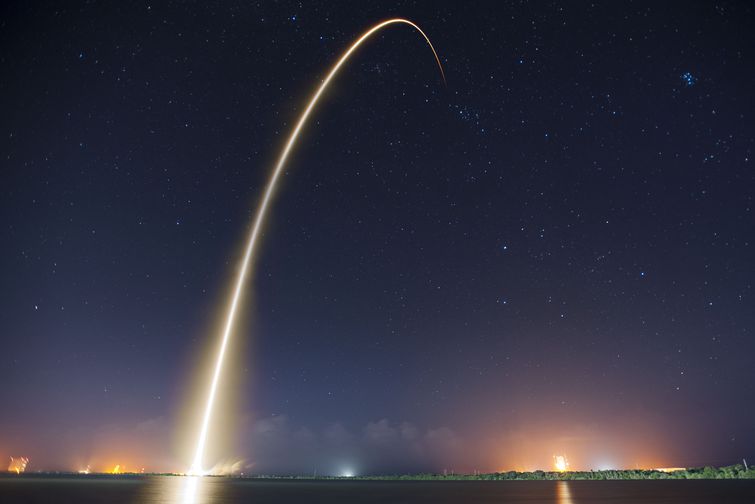
Saturday morning, SpaceX launched its fifth cargo resupply mission to the International Space Station, part of a collaboration with NASA.
But this time SpaceX, nearly did something unprecedented afterward: the first stage of its Falcon 9 rocket landed vertically on a platform floating in the Atlantic Ocean a few minutes after its job was finished. However, the rocket touched down too hard because it ran out of hydraulic fluid, and was damaged in the process:
Normally, rockets are simply allowed to break up into pieces or sink in the ocean after each use. A controlled landing of the rocket could have allowed SpaceX to reuse it on a future flight — and reusing this multi-million dollar piece of equipment, rather than throwing it out after every flight, could dramatically drive down the cost of space travel.
spacex platform
The landing platform, which was damaged during the hard landing. (SpaceX)
But even if the rough landing destroyed the rocket, just placing it accurately on the platform was a big step in the right direction. The company admitted this was a difficult maneuver with a high chance of failure beforehand, and it's expected they'll keep trying in future launches.

What SpaceX was trying to do

The company launched a Falcon 9 rocket from Cape Canaveral, Florida, in order to carry an uncrewed space capsule up to the International Space Station. The Dragon capsule will deliver all sorts of cargo to the ISS — food, life support equipment, and several scientific experiments — when it arrives there on Monday.
The rocket that launched the capsule into space is made up of two parts: a 138-foot-tall first stage, which burned for the first few minutes of flight, lifting the craft up to an altitude of about 50 miles before separating and falling back to Earth, and a smaller, 49-foot-tall second stage, which burned for another five minutes or so, carrying the spacecraft into orbit before disconnecting and falling back down to earth as well.
Usually, both of these stages — as well as the stages that make up other rockets in general — break up into pieces as they plummet downward, eventually sinking in the ocean and becoming unusable. But today, as the first stage fell back to earth, SpaceX fired its engines in order to stabilize and guide it for a controlled landing on an autonomous uncrewed barge, stationed about 200 miles east of Jacksonville, Florida, as shown in the graphic at right, from Space.com.
As the rocket descended, steerable fins affixed to its outside helped guide it and slow it down. As it neared the barge, a set of legs unfolded from the bottom of the rocket, and the rocket gently landing on them, fully upright at a speed of about 4.5 miles per hour.